PRODUCTION
Feeding the world in a sustainable way is one of our most pressing challenges in the coming decades. Meat plays a pivotal role in this. Global meat consumption has increased rapidly over the past 50 years – It has been estimated that global meat consumption may double from 2000 to 2050.
YOUR CHOICE
Do you know how many green house gases went into your plate?
EMISSION
Compared to the other food, the production of meat has large environmental impacts, among which, the most severe one is increasing greenhouse gas emissions.
ENERGY EFFICIENCY
Meat takes much more grain, land and water to fatten an animal to produce a pound of meat than it does to grow the same number of calories in the form of grain that is eaten directly.
Everyone's diet matters to our planet.
Do you know how many greenhouse gases went into your plate?
Select the food you had today, hover on the chart to see more details.

AR Study Design And Evaluation
on understanding the impact of AR on the dynamics of users' co-located collaboration
Evaluating how Augmented Reality balances and strengthens collaborative problem-solving and learning: qualitative and quantitative data analysis
Research phase: 12 weeks
Toolkit: Python, HoloLens, Unity
Responsibility:
Design evaluation system
Run user study
analyze qualitative and quantitative data
@Harvard Leaning, Innovative, Technology Lab

We hypothesize that in pair tasks, augmented reality visualizations can allow weaker participants to contribute to the problem-solving process such cases of imbalance, by encouraging communicative grounding and reducing information-seeking behaviors, leading to more balanced group collaborations.
Introduction
While the effects of AR experiences on learning have been widely studied, there is relatively less research on understanding the impact of AR on the dynamics of co-located collaboration.
In this study, we investigate how AR information influences balanced and imbalanced groups, in the context where two students learn to program a robot. To solve such tasks, users must work together to understand how a robot uses multiple sensors to detect its location in relation to the real world. In this study, we look at data collected (N=40) in which pairs of participants were tasked with solving a maze using a programmable robot under AR and non-AR conditions.
Typically the sensor values are visible on a computer screen which is also used to program the robot. This task creates an imbalance due to the fact that information about the robot, as well as the ability to control the robot, are localized on the computer screen; which naturally tends to a task distribution where one person operates the computer while another manipulates the robot without easy access to the programming interface and the sensor values. The asymmetry of information is compounded in cases where one participant starts the task with more knowledge than the other, thus causing them to dominate the problem-solving process.
Study Design
In this study, we investigated how augmented reality influences novices programming a robot in pairs. We investigated the following research questions:
RQ1. How does the presence of AR impact the balance of collaborator contributions ?
RQ2. How does the presence of AR impact the types of problem solving contributions ?
The research questions were investigated through a between-subjects design, with presence/absence of
AR as the independent variable, and metrics of learning and collaboration as dependent variables.
All participant groups were tasked with the same activities, which required participants to program a robot to move around a maze and achieve specific goals associated with each activity. In this task, participants were imbalanced in their proximity to access a computer, which provided information about the robot and allowed programming of the robot.
The robot was constructed out of a GoGo Board, an open-sourced educational hardware device, and contained proximity sensors (to detect distance to walls), a magnetic field sensor (to detect magnets in the floor), and light sensor (to detect flashing lights from the walls)

In the current study, participant pairs were separated according to the presence of Augmented Reality: Participants were randomly assigned to one of two experimental conditions (AR or Non-AR) which varied on the presence of augmented reality features.
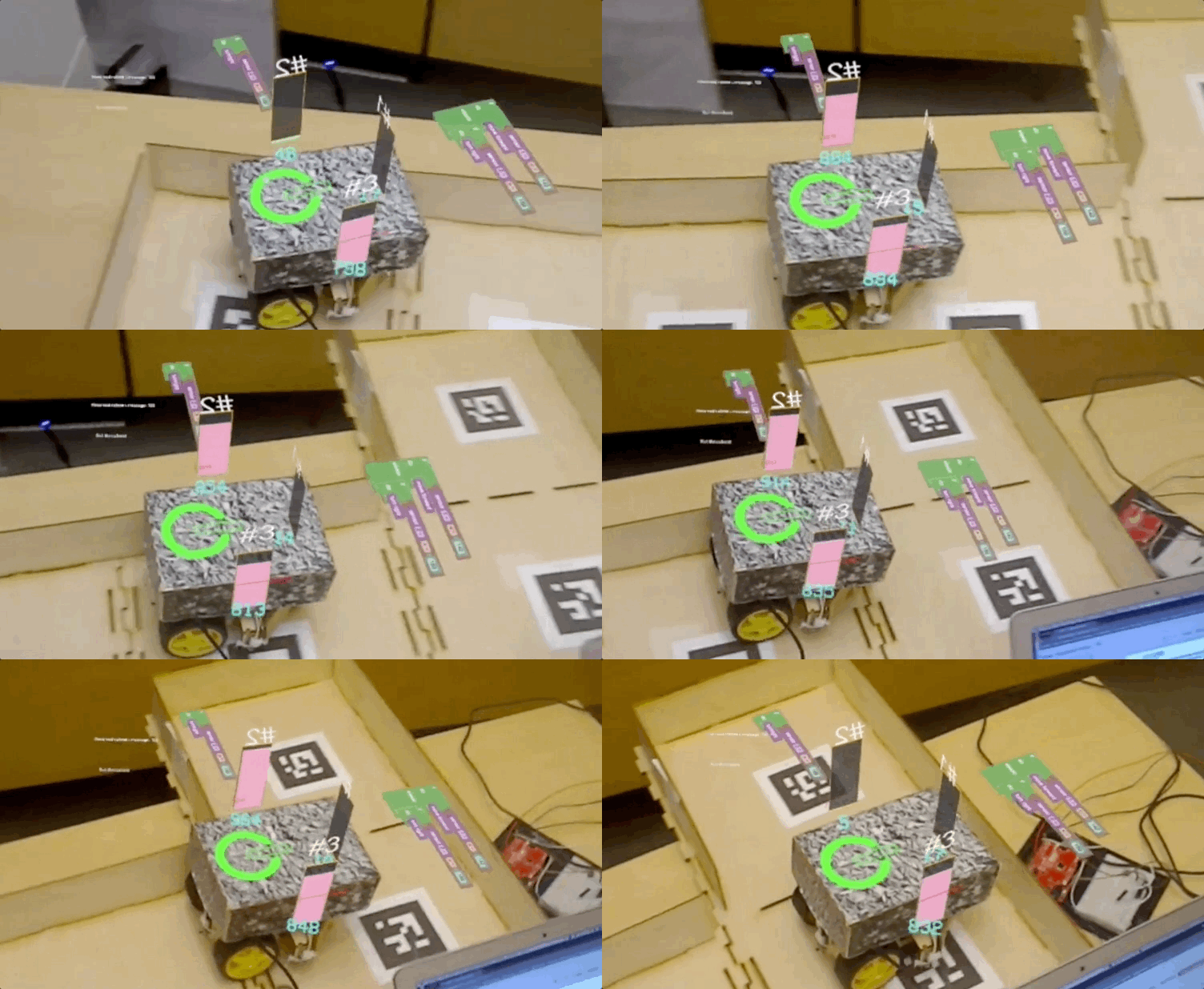
In the Augmented Reality condition, participants wore a Microsoft Hololens headset which overlaid visualizations on top of the robot.
The AR visualizations were composed of:
(1) a static rectangular area overlaid on the robot indicating whether the robot’s program is currently running or not;
(2) text labels indicating the sensor number above each physical sensor;
(3) text labels indicating what is the purpose of each sensor (ex: proximity, magnetic, light);
(4) bar charts showing bars and sensor values
In the Non-AR condition, participants similarly wore the Microsoft Hololens device, but saw only the AR augmentation (1) described above; i.e. a static rectangular area overlaid on the robot indicating whether the robot’s program is currently running or not. This group did not see any of the other augmentations visible to the AR group. This Non-AR group served as the experimental control group.


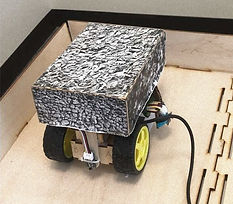

The robot as it appears without AR holograms
Participants interacting with robot and maze
Task: Moving robot in maze
The robot seen through the AR headset, showing sensor types and real-time values
Evaluation System Design
We designed an evaluation system based upon
a. Video recording of participants' behavior
b. Pretest questions
c. Posttest questions
d. Post survey

Then following the structure below, we qualitatively and quantitatively analyze the collected data of participants.


Evaluation Results


Results Interpretation
Based on the results and qualitative observations above, multiple hypotheses can explain our findings. The presence of AR caused a balancing of contributions and reduced imbalance as participants learned over time. This effect was most visible in groups that had imbalanced expertise. This suggests the possibility that in AR condition, participants learn together and contribute at comparable levels (as seen above) in contrast to their Non- AR counterparts. We hypothesize that the increased access to relevant information (as seen by the lower time spent by AR participants in looking for important information) in an intuitive manner increases participants’ opportunities to contribute to problem solving. In problem solving environments, this could encourage weaker participants (ex. participants with lower starting expertise) to contribute to problem-solving process.
Furthermore, when AR was present, participants spent less time searching for important information from the system. We observed that this freed up time for participants to contribute more deeply to the conversation. Participants spent more time trying to reach a common ground/understanding and being involved in hypothesis- driven actions when using AR. The constant presence of AR saves time for its users and participants can focus more on the problem at hand. As AR provides both participants with important system information in an intuitive manner, participants tend to spend more time verbalizing their processes and observations.
Augmented reality visualizations had an impact on problem-solving processes, whereby the presence of AR encouraged participants to use more hypothesis-driven processes and less trial and error processes. In an educational setting, relying on trial and error processes limits participants from gaining a deeper understanding of the phenomenon underlying the problem, and it is possible that the presence of AR can encourage collaborative learning behaviors that lead to more complex problem solving and deeper understanding for participants.
We acknowledge that this research contains several limitations. Although the observations are likely to apply more generally, further analysis is needed to determine how generalizable the findings are, and what nuances occur in the larger dataset. Additionally, other coding schemes include social components of problem solving, as metrics for how groups process information. The current coding scheme ignores social contributions of participants, and instead focuses on cognitive contributions. Future work is required to investigate the impact of AR on the social contributions of participants.